
In a ManuVision treatment, we work to both relieve and prevent tension headaches. By releasing tension in the shoulders and neck, regulating the nervous system, and activating deep breathing, we help restore balance in the body.
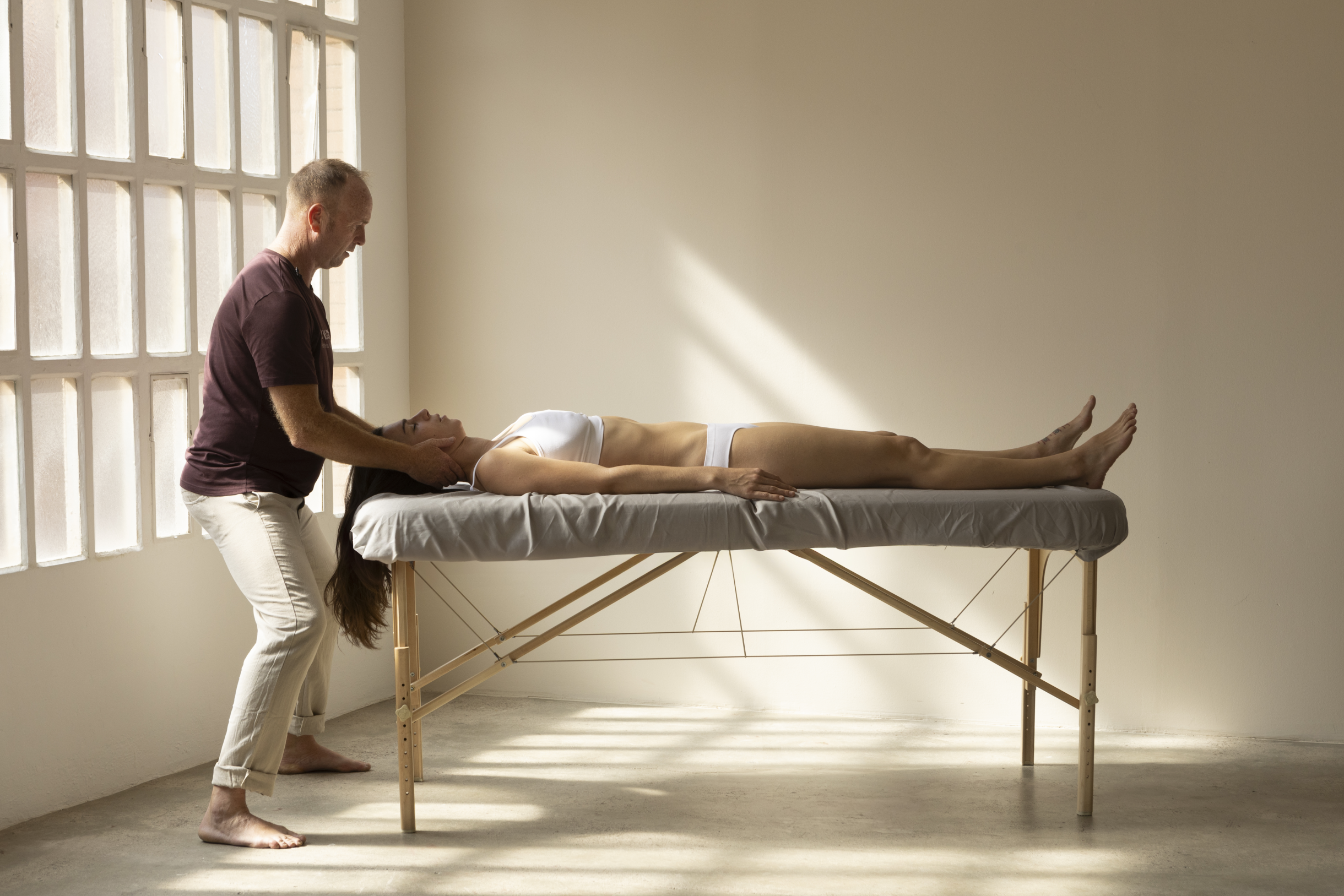
Here, you can learn more about what causes tension headaches and how they can be treated and prevented—both through ManuVision body therapy and with simple exercises you can practice on your own in everyday life.
What causes tension headaches?
Tension headaches are a general term for different types of headaches caused by muscle tension elsewhere in the body—typically in the neck, shoulders, or both.
They are often triggered by sedentary work, prolonged screen use, or stress, and can be understood as one of the body’s signals that something needs to change.
Breathing also plays an important role, as it does in many other areas of health. Shallow breathing can cause energy to build up in the head, and when we are not connected to our deeper breath, the body struggles to circulate that energy and release tension in the neck, shoulders, and back.
Sedentary Work and Tension Headaches
Tension headaches are very often associated with sedentary office work. This type of work can be challenging for the body for two main reasons:
- When we sit still, the body is not very active and therefore does not require as much oxygen. This means that it doesn’t automatically engage in deep breathing, as it is not “necessary.” However, when we don’t breathe deeply, energy is not distributed throughout the body. Instead, it tends to move upward and accumulate in the head—which can contribute to tension headaches.
- When working at a computer, it is primarily the hands and their fine motor movements that are active. The larger muscle groups in the rest of the body remain relatively passive. As a result, the body’s physical load is not distributed evenly, and muscles—especially in the neck and shoulders—can become locked in fixed positions. Over time, this tension can lead to the onset of tension headaches.
Screen Use and Tension Headaches
Our screen use also has a direct impact on the muscles and areas of the body that can trigger tension headaches. This is closely related to how we use our eye muscles when working at a screen. When our gaze is fixed on a screen, the eyes are locked into a static position based on the viewing distance. As a result, the eye muscles experience very little movement and tend to become tense.
The muscles in the neck are sometimes referred to as the “large eye muscles,” as they help control the position of the head while the eyes are working. Just like the eyes, the head moves very little during screen use. This can lead to tension in the neck, which is a common contributor to headaches.
Stress and Tension Headaches
Tension headaches can also be a response to stress and inner unrest in the body. When we are stressed, we often experience racing thoughts and worry, which can lead to a buildup of energy in the head and result in headaches.
Stress is also a sign that the nervous system is overloaded. An overwhelmed nervous system affects deep breathing and can cause muscle tension—especially in the neck and shoulders—which may trigger tension headaches.
When tension headaches are stress-related, it can be helpful to work on setting boundaries and becoming more aware of the body’s signals.
Treatment of Tension Headaches
In a ManuVision treatment for tension headaches, we work to both relieve and prevent symptoms by:
- Activate deep breathing, allowing energy to flow throughout the body and releasing tension caused by shallow chest breathing
- Release tension in the shoulders and along the base of the skull, freeing the neck
- Balance the nervous system so the body can use its resources more
- efficientlyIdentify the underlying causes of tension headaches
How can you prevent tension headaches?
If you have a sedentary job in front of a screen, we recommend the following simple exercises to help relieve and prevent tension headaches:
- Stay connected to your feet: To help distribute the energy that builds up in the head during sedentary work, it’s important to maintain good contact with your feet. This means being aware of how your feet rest on the surface beneath you. When your feet are “grounded,” energy can flow more freely throughout the body—helping to prevent the buildup in the head that can trigger tension headaches.
- Focus on a point far from the screen: To support and vary the work of the eye muscles, it’s a good idea to take regular short breaks where you look away from the screen and focus on something in the distance. Shifting your focus allows the eyes to move out of their fixed position and get a natural break, which can help reduce the neck tension that may lead to headaches.