
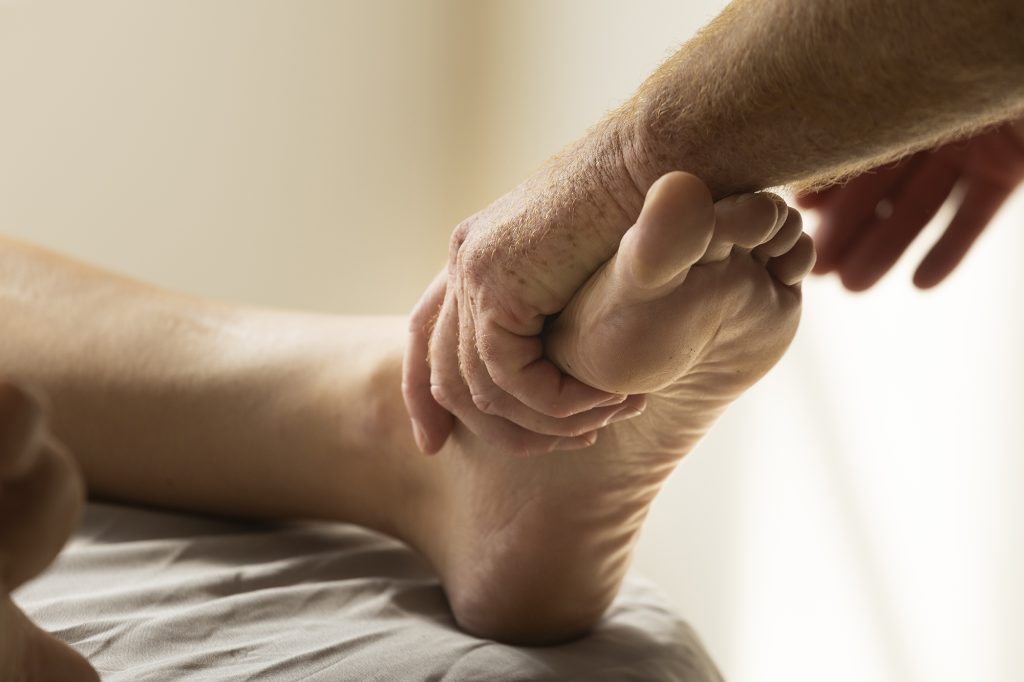
Pain in the knees, hips, and ankles can often be traced back to stiffness in the feet and a lack of coordination between the knee, ankle, and hip joints. In a ManuVision treatment, we therefore focus on restoring mobility in the feet, ankles, knees, and hips, allowing these elements to work together as an integrated whole. When they function in harmony, they are less prone to overload—and therefore also less likely to develop tension and pain.
What causes knee pain?
Knee pain is very common, affecting both younger and older people. It can arise from various types of overuse as well as conditions such as arthritis. The knee is a particularly vulnerable joint, as it is structurally the weakest of the three joints in the leg (hip, knee, and ankle). It is primarily held together by tendons and muscles that support its many მოძრable parts.
Although the knee is relatively flexible compared to other joints in the body, it is designed to function in coordination with the hips and ankles. Knee pain therefore often occurs when the ankles and hips are restricted or lack mobility. In these cases, the knee ends up carrying more load than it is built for.
When knee pain does not have a clearly defined cause, the focus should be on creating more freedom and flexibility in the ankles and hips. When the ankles, hips, and knees are able to work together, the load on the knees is reduced—making them less prone to strain and pain.
Knees and Sensitivity
On a psychological level, the knees can reflect how we stand emotionally in life. Because the knee is both a flexible and vulnerable joint, it is also associated with a certain sensitivity—one that can be difficult to fully acknowledge and manage. While sensitivity is essential for being able to feel and process emotions, it is often perceived as a weakness, as many people struggle to relate to their emotional life.
A common pattern of tension is therefore to compensate for this sensitivity by tightening and bracing. Hyperextended knees are one example of how we may try to maintain control physically—something that can place significant strain on the lower back, ankles, and hips.
From an energetic perspective, the knees are often linked to the solar plexus and digestive energy. The stomach meridian passes through the knee, and imbalances in this system are associated with digestive issues, headaches, neck pain, increased sensitivity to stress, and knee problems.
What causes ankle pain?
When treating ankle pain, we first look at the feet and overall foot posture. The foot is evolutionarily designed to move across uneven terrain, but because modern life mainly takes place on flat surfaces, our feet rarely get the chance to use their full range of movement and capacity.
The ankle and foot are designed to function together, and when the feet become restricted or stiff, this also affects the ankles. As a result, the ankles may not develop the strength and mobility needed to become resilient against sprains and similar injuries. The nervous system, which is designed to respond quickly to external stimuli, can also become less responsive in areas that are not regularly activated. In essence, improving ankle health involves restoring mobility in the feet and re-establishing a strong, stable connection to the ground, which supports both foot and ankle function.
In treatment, we assess tension patterns in the ankles and related joints, working to improve circulation, mobility, and flexibility in order to reduce stiffness and pain.
What causes hip pain?
Hip pain is often connected to the condition of the knees and ankles, so treatment typically examines the relationship and coordination between these three joints. Tension in the shoulders can also negatively affect the hips (and vice versa), as both act as part of the body’s overall compensatory tension system within the spine. These tension patterns are often diagonal, meaning that tightness on one side of the hip may be linked to tension in the opposite shoulder.
A key structure in hip function is the psoas muscle, which connects the upper and lower body and plays an important role as a hip flexor. For this reason, treatment of hip pain often includes releasing tension in the psoas and easing tightness in the lower back.
The hip joint is part of the pelvis, which—like the feet—serves as a foundation for the body. The hips connect the upper body to the legs, which carry us through the world, and tension in this area can therefore influence how we move and experience life. While grounding through the feet relates to stability and connection with the external world, grounding through the hips relates more to internal stability and the ability to feel at ease within oneself.
From an energetic perspective, the hips are associated with the gallbladder. Stiffness in the hips is often seen as a sign of imbalance or blockage in this area, which is traditionally linked to drive, decision-making, and expressions of anger.