
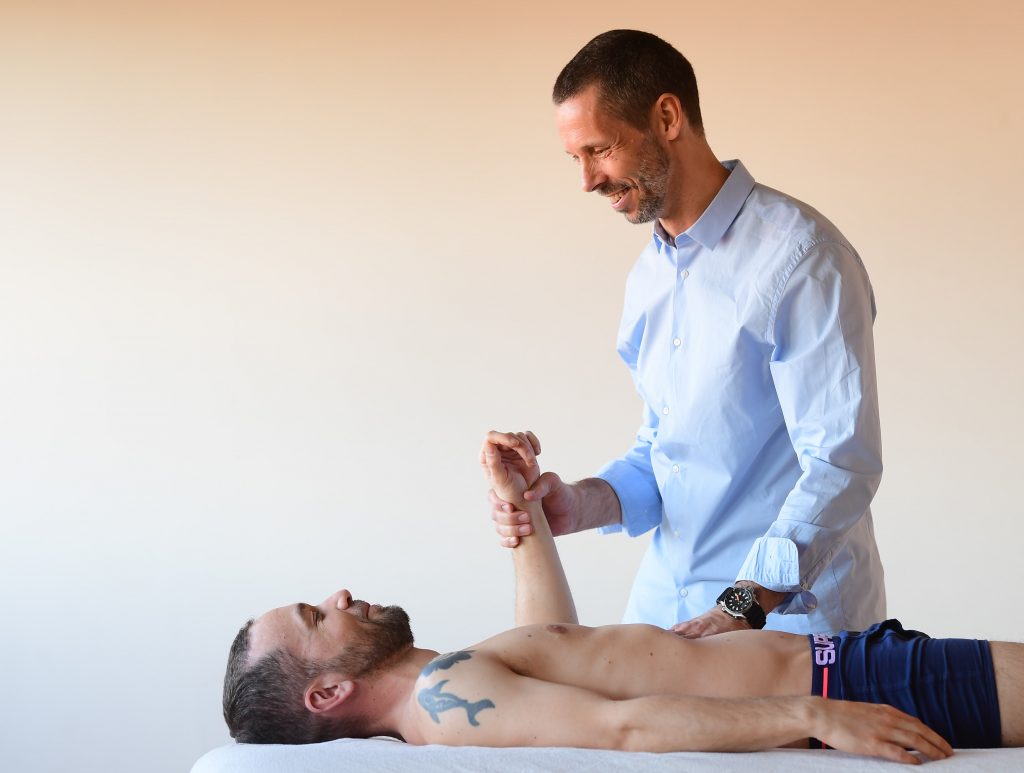
Pain in the shoulders, elbows, and wrists—as well as conditions like tennis elbow, golfer’s elbow, and repetitive strain—often results from poor coordination between these joints. In a Manuvision treatment, we identify which joint is restricted and restore movement so the joints can work together smoothly. When they move in harmony, the risk of overuse, tension, and pain is greatly reduced.
What Causes Shoulder Pain?
The saying “carrying too much on your shoulders” is a very literal reflection of how our shoulders are physically affected when responsibilities become a burden. Mental stress often settles in the shoulders just like physical tension, locking the muscles and causing pain that can spread to the neck and even lead to tension headaches.
From a physical perspective, the shoulder is a complex joint with many muscles and tendons. Unlike the hip, where the socket surrounds the femur head, the upper arm bone rests only on the shoulder blade. This gives the shoulder great mobility, but also makes it less stable and more vulnerable than many other joints in the body. When the shoulders are tense, arm movement is restricted, which can create problems in the elbows and wrists and contribute to conditions such as tennis elbow, golfer’s elbow, and repetitive strain injury.
The Shoulders as Protectors
A common tension pattern is shoulders that have “fallen forward.” This forward rotation reflects a basic protective mechanism: the arms naturally shield the soft and vulnerable parts of the body and the vital organs behind the chest and abdomen. Over time, however, this protective posture can become permanent, reducing shoulder and arm mobility and affecting the elbows and wrists as well.
Energetically, the shoulders are connected to the lung meridian, which is linked to emotions like grief and the tendency to “collapse” the shoulders to protect sensitive areas of the body, especially the solar plexus. By addressing both the physical and energetic tension, Manuvision treatments help restore movement, balance, and ease throughout the upper body.
How We Treat Shoulder Pain
When we treat shoulders, we look at the balance between both shoulders, as pain in one shoulder often relates to tension in the other. We also examine the back muscles, which play an important role in shoulder function, because tension here can affect the shoulder blade and collarbone, contributing to restrictions in the shoulder. Finally, tension in the shoulders can often be traced to tension in the hips, as a diagonal “line of tension” runs between the hip and shoulder.
What Causes Elbow and Wrist Pain?
The elbow connects the shoulder and wrist, and it bears extra strain if either of these joints is restricted. Elbow pain often originates from tension in the shoulders, which are frequently locked in a forward rotation. This rotation limits arm mobility and affects how the hands perform their work. When the shoulder joint is blocked, the elbow ends up carrying more weight than it is designed for. Conditions like tennis elbow and repetitive strain (pain on the outside of the arm) or golfer’s elbow (pain on the inside of the arm) are often the result of locked, forward-rotated shoulders.
How We Treat Elbow and Wrist Pain
In a Manuvision treatment for elbow and wrist pain, we focus on helping the chain of three joints—the shoulder, elbow, and wrist—work together more effectively. We release and open the shoulders and create circulation in the surrounding tissues. We also improve lymphatic flow, because the more tense the shoulders are, the poorer the lymphatic circulation down the arms.